
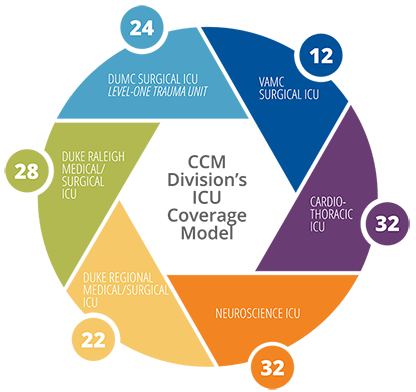
The Critical Care Medicine (CCM) Division provides patient care, teaching, and research in seven intensive care units, as well as perioperative medicine programs, across the health system.
Surgical Intensive Care Unit (SICU), Duke University Hospital
The SICU at Duke University Hospital is a 24-bed Level 1 trauma unit. In addition to providing multidisciplinary care for trauma patients, it serves as a site for care of a variety of postoperative general and subspecialty surgical patients, including abdominal transplantation. Attending staff from the Departments of Anesthesiology, Surgery and Medicine lead the multidisciplinary patient care teams. The unit is co-directed by Dr. Nitin Mehdiratta.
Cardiothoracic Critical Care Unit (CTICU), Duke University Hospital
The CTICU at Duke University Hospital is a 32-bed unit providing care for patients undergoing cardiac or thoracic surgical procedures. This includes patients undergoing coronary artery bypass grafting, minimally invasive cardiac surgery, adult congenital heart surgery, valvular heart surgery, electrophysiologic surgery, pulmonary transplantation, cardiac/pulmonary transplantation, implantation of advanced artificial cardiac support devices, and thoracic surgery. Attending staff from the Departments of Anesthesiology, Surgery and Medicine lead the multidisciplinary patient care teams. The unit is co-directed by Dr. Ian Welsby.
Neurological Intensive Care Unit (NICU), Duke University Hospital
The NICU at Duke University Hospital is a 32-bed unit that cares for patients with critical neurologic problems, including stroke, traumatic brain and spinal cord injury, and post-operative neurosurgical patients. Attending staff from the Departments of Anesthesiology and Neurology lead the multidisciplinary patient care teams.
Surgical Intensive Care Unit (VA SICU), Durham Veteran’s Affairs Medical Center
The VA SICU is a 12-bed unit providing care to a variety of critically ill surgical patients at the Durham VA Medical Center. Approximately 40 percent of the patients are postcardiothoracic surgery patients, with the rest typically being high-risk general, vascular, urology and neurosurgery patients. Attending staff from the Departments of Anesthesiology and Surgery lead the multidisciplinary patient care teams. The unit is directed by Dr. John Lemm.
Critical Care Unit (DRH ICU), Duke Regional Hospital
The DRH ICU is a 22-bed unit providing care to all critically ill patients at Duke Regional Hospital. The medical conditions treated in this unit are broad, including medical, surgical, cardiac, neurologic, and obstetric critical illness. Attending staff from the Departments of Anesthesiology, Medicine and Surgery lead the multidisciplinary patient care teams. The unit’s associate medical director is Dr. Kathleen Claus.
Intensive Care Unit (DRaH ICU), Duke Raleigh Hospital
The DRaH ICU is a 28-bed unit providing care to all critically ill patients at Duke Raleigh Hospital. Similar to DRH ICU, the conditions treated in this unit are broad, including medical, surgical, cardiac, and neurologic critical illness. Attending staff from the Departments of Anesthesiology, Medicine and Surgery lead the multidisciplinary patient care teams. The unit is directed by Dr. Robert Clark.
Intensive Care Unit (DHLN ICU), Duke Health Lake Norman Hospital
The DHLN ICU is a 12-bed unit providing care to all critically ill patients at Duke Health Lake Norman Hospital, primarily via tele-critical care services. Conditions treated in this unit are broad, including medical, surgical, cardiac, neurologic, and obstetric critical illness. Attending staff from the Departments of Anesthesiology and Medicine and lead the multidisciplinary patient care teams.
Perioperative Medicine
The perioperative medicine programs provide care for patients undergoing major surgery. Services include preoperative assessment and optimization, critical care management, inpatient optimization of medically complex surgical patients, and recovery programs following major surgery and critical illness. Patients managed through these programs are diverse and include those with multiple chronic medical conditions, frailty, functional impairment, and other factors associated with increased perioperative risk. Attending physicians from the Department of Anesthesiology lead multidisciplinary teams dedicated to improving perioperative outcomes and recovery.