
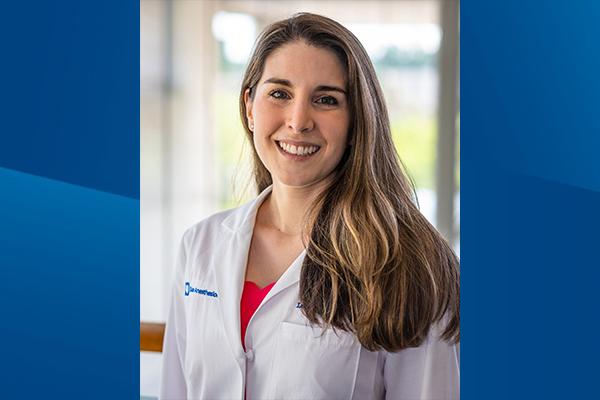
Duke Anesthesiology’s Leah Acker, MD, PhD, has been selected for the 2025 McKnight Brain Research Foundation Innovator Award in Cognitive Aging and Memory Loss, one of the most prestigious awards in neuroscience for early to mid-career faculty. The award—administered by the American Federation for Aging Research— supports two high-risk, potentially transformative projects each year and will provide $750,000 to fund Acker’s investigation, “Inflammatory Hangover and Cognitive Aging.”
Acker has introduced the concept of an “inflammatory hangover”—a prolonged, maladaptive immune response to minor stressors. Building on her team’s recent work establishing the brain-heart-immune axis and its role in delirium resilience, she proposes targeting this axis with a novel intervention to prevent inflammatory hangovers and slow cognitive aging. This study will test whether noninvasive vagus nerve stimulation can strengthen resilience by shutting down excessive inflammation before it affects the brain.
“I am grateful for what this award allows us to pursue as a department and a specialty. Anesthesiology offers a unique vantage point on aging neuroscience, revealing cognitive vulnerabilities during physiological stress that traditional approaches cannot access,” says Acker. “Neuroscience provides the tools to understand these clinical observations and to develop interventions that strengthen resilience and slow cognitive aging. I am grateful to our department and to Duke for the collaborative environment that makes this kind of multidisciplinary work possible.”
Acker proposes that everyday physiological stressors—such as minor surgeries, injuries, and infections—may be overlooked but modifiable drivers of long-term brain health. This perspective broadens aging neuroscience by focusing on healthy, high-functioning older adults, a group rarely studied but “arguably with the most to lose in cognitive aging,” says Acker. Her clinical practice gives her team a real-time view of stress physiology that complements the mechanistic tools of modern neuroscience.
Her team’s recently completed NIH-funded study—“Heart Rate Variability in Postoperative Delirium and Postoperative Inflammatory Endpoints” (HiPPIE)—established wearable-device methods and signal-analysis techniques that identified a mechanistic link between impaired preoperative brain-heart-immune axis function, excessive postoperative inflammation, and elevated delirium risk. The new study builds directly on these findings with a randomized controlled trial that tests for the first time whether modulating brain-heart-immune axis function with noninvasive vagus nerve stimulation can strengthen neurocognitive resilience and slow cognitive aging in healthy older adults.
This project strategically expands Acker’s translational neuroscience and engineering program, which has completed two clinical studies in less than four years, with a third NIH-funded study ongoing. This fourth study will continue to advance a multidisciplinary research agenda spanning cognitive neuroscience, resilience, perioperative brain health, and aging. With its novel conceptual framework, mechanistically informed intervention, and longitudinal design, this work aims to preserve memory and resilience long before decline becomes detectable—further strengthening Duke Anesthesiology’s leadership in perioperative brain health.