

SHAPING THE FUTURE OF ANESTHESIOLOGY: Faculty Spotlight

I will forever be drawn to the art of medicine equally as I am, the science of medicine.” For anesthesiologist Adjoa Boateng Evans, MD, the boundaries between art and medicine often blur into a beautiful synthesis.
A passionate champion of medical humanities, Boateng Evans is convinced that art and science will inevitably amalgamate in the future. “The more that emerging technologies like artificial intelligence and large language models streamline the mechanics of our work, the more physicians will reconnect with what drew many of us to medicine: humanity, stories, connection, helping, and healing. There remains such a vast unearthed area of medicine that we’re just beginning to understand because of our necessary focus on the science, but I look forward to seeing how these two interconnected layers come together.”
Since joining Duke as a clinical assistant professor in the Department of Anesthesiology in 2023 from Stanford, Boateng Evans has brought her humanistic lens to her work in the operating rooms and intensive care units. She draws a compelling artistic parallel between the intricacies of the teamwork required to perform a complex surgery and a well-choreographed orchestra, recounting her amazement at witnessing her first open-heart surgery as a medical student.
“This was choreography,” she remembers with wonder. “No one was talking. Everyone was moving, doing. The patient was anesthetized. The surgeon walked in, and much like a conductor, brought the ‘orchestra’ together.” She emphasizes that, just as in a theatrical production, if any piece goes awry, everything stops—a reminder of medicine’s inherent teamwork.
Boateng Evans’ journey to anesthesiology was circuitous and deeply informed by her unique upbringing. Growing up in the New York City metropolitan area with abundant access to arts and theater, she was keenly sensitive to the stark socioeconomic disparities around her—the conspicuous wealth in equal presence as poverty and homelessness. This very unequal distribution of resources, with art however being an accessible constant, would fuel many of her later pursuits.
After earning her Bachelor of Arts degree in the History of Science and Medicine from Yale University in 2007, Boateng Evans worked as a clinical research coordinator at Mount Sinai Hospital, enrolling intravenous drug users in East Harlem for a hepatitis C treatment study. Her work took her to needle exchange programs in homeless shelters and on mobile health care vans bringing care to underserved communities. Often, her assignments led to caring for those at the margins of society.
In stark contrast, another initiative later took her to the world renowned Betty Ford Center in Rancho Mirage, California. There, she learned more about addiction through the lens of privilege. The experiences would cement that certain disease states, “don’t discriminate,” planting a seed to better understand this phenomenon in medicine. “For someone who grew up in middle class, it was a very eye-opening experience,” says Boateng Evans. This pervasiveness of disease and human-to-human connection drew her into medicine and ultimately to anesthesiology and critical care.
Boateng Evans describes her upbringing as “binary” with highly educated parents - a father who immigrated from Ghana and a mother from New Jersey. Both instilled in her an ethic and value system colored by grit, gratitude and hard work. “There was an expectation that mediocrity is unacceptable, and you don’t accept things that are sub-par.” As one of very few African American female physicians in critical care medicine (4% of all intensivists are African American), her experiences strengthened her resolve to not only treat disease with the best that science offers but, more importantly, to treat humans with the dignity they deserve.
Over the years, Boateng Evans completed a Master of Public Health degree from Drexel School of Public Health (2011), earned her MD from Robert Wood Johnson Medical College (2015), completed her anesthesiology residency at Yale New Haven Hospital (2019), and then acquired her Critical Care Anesthesiology Fellowship at Stanford University Medical Center, joining the faculty thereafter. In 2023, drawn by a desire to be closer to family on the east coast, she joined the Critical Care Medicine Division at Duke.
Boateng Evans views anesthesiology as “a great equalizer” that levels the playing field. “Whether you’re homeless or a CEO, everyone gets the same gown, everyone’s body gets scrubbed and draped in blue towels. The surgery and provision of anesthesiology don’t change overtly because of social differences. That was very inviting for me.” The academic aspects of anesthesiology—its interplay of pharmacology and physiology and watching medications work in real time—fascinate her. She’s excited about how the field is transforming patient care with cutting-edge technology. “A lot of what we do in the operating room is minimally invasive, which 10 years ago would not have been fathomable,” she explains enthusiastically.
As a woman of faith, Boateng Evans finds that anesthesiology brings her “closer to God” through what seems like daily miracles. “We bring patients to the brink of death in a medically induced coma and then bring them back to life,” she reflects with wonder. She prays for her patients while driving to the hospital and for the surgical teams she’ll work with, especially before particularly challenging cases. “We did a brain surgery on a pregnant woman some months back, so we had two patients that day, which was atypical. I felt I needed a divine guiding light to make sure things went well. They did. The patient might forget me; I will never forget her.”
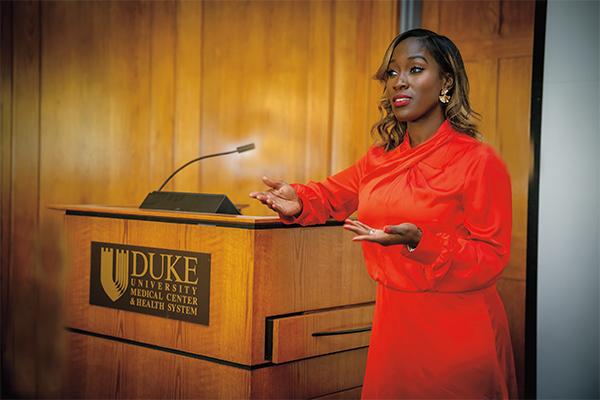
Washington and Lee Talk
“In Critical Condition: A State of the Union
on Compassion, Death and Purpose.”
Dr. Boateng Evans uses storytelling to emphasize bringing equal purpose to the end of our lives as we are planning the multiple other aspects of our lives.
It is critical care medicine that brings this humanitarian even closer to humanity. “We have the opportunity to heal—even just by taking a few extra moments to be kind, to connect with people awaiting surgery. Whether it is sitting at eye level, giving space to address subtle concerns or praying with them,” she says. She advises trainees to help craft how a family’s ICU experience will be remembered, emphasizing the importance of clear language and thoughtful non-verbal communication in bridging the gap between medical understanding and patient comprehension.
“We can use the tool of language to relate to humanity,” she explains. Boateng Evans recounts spending many hours with the daughter of a cardiac arrest patient, “explaining the same information in various ways until it was digested, using the gift of language to find a combination of words that stuck.” Sometimes they would pray together, sometimes sit in supportive silence. “I learned a lot about their family—their sense of unity and discerning fortitude, their warmth, their love.” Months later, after the patient was discharged, Boateng Evans received an invitation to celebrate the patient’s life with the family, which she says, “felt like the highest honor.”

Tedx Talk:
“The Prophesy of Pain”
Dr. Boateng Evans flips the notion of pain on its head to reconsider it not only for its role in discomfort but truly as a warning sign for something greater. When we feel pain, whether emotional or physical, it typically is for some other purpose. How suffering, tragedy and hardship can be a warning sign for something greater on the other side – a redeeming effect. To understand how to fully experience joy, one must often first experience hardship.
Photo: Dr. Boateng Evans giving a TEDxAccra Talk in April 2016 in Ghana.
Grief, What is Your Name?

Today, I write to those entities my mind cannot digest.
To the novel tastes that defy even umami, the ones chewed, looking upwards, with eyes closed, to give my tastebuds a bit more bandwidth.
Today I write to you, grief.
You arrive indiscriminately, luggage brimming with both overwhelming cacophony and also deafening silence.
You disrupt conversation, causing coffee to spill over freshly pressed linen.
I weep.
What was once the fluid and graceful nature of my tongue begins to stutter through poorly concocted words or use inappropriate comedy because life sometimes, is too much to bear.
Paradigm shift.
Grief is when the life preceding no longer mirrors life thereafter.
So I pause, stare towards the muted tones around me and whisper, “Grief, what is your name?”
When we are already in mourning and there is more death, what do we call it? From where does more pain emanate when numbness prevails? How do more tears spring from a dried well? Grief, who birthed you? From whose womb were you nourished and sung lullabies? What bosom fed you emotion-scattered, overwhelming, speechless pain? How did your mother come to be? Did she adorn with delicate, yet decadent lace that lingers long after death bringing reminders of what was, via song, scripture or sermon?
I ask you, again, grief, what is your name??
Do your eyes puff with sunrise’s trickling red, yellow and orange embers as you awake from a night of tear-stained weeping; a reminder that the escape of dreaming is over.
Grief, do you also wish that same sleep would rescue you back to dream, because reality is too harsh, too stinging?
Acid to an open wound?
When the tone of my mother’s voice becomes less rhythmic, more monotone, less laugh-filled, more littered with pause - I want to almost say the words with her as if to blunt the stab when she breathes deeply and whispers, “I have some bad news.”
But grief, I don’t know you.
Not like this.
You are to come with warning, preparation, a chance to reconcile replaying voicemails when a voice is no longer.
A chance to find old pictures when flesh travels to morgue. You are to give us opportunity to go through ritual.
We need ritual…or so we thought.
Your son – tragedy, robs and steals from us. So we stand, rather, we crumble, shell-shocked.
Stranger, what is your name?
Until we meet again.
But oh! Shall I never you meet again. You make the taste of my own mortality too sweet.
Anesthesia & Analgesia, July 2021. DOI: 10.1213/ANE.0000000000005596
Bringing a Healing Aspect to Anesthesiology:
Remember that most patients are petrified on the day of surgery. Personalize the conversation, don’t rush, avoid excessive jargon.
Read the room when using comedy, most importantly, use wisely. There are patients and families for whom comedy helps humanize the experience diffuse tension. Others will perceive jokes as wholly inconsiderate and terse during this important time.
Remember names and use them often. Of patients, of families, of colleagues. So much of our identity and humanness stems from our name.
How Medical Humanities Combats Clinician Burnout:
Getting to the heart of physician professional identity and helping doctors reconnect with their purpose through art.
In medicine, we are all storytellers. It is the bloodline by which we communicate. Realizing that this craft can shape how we see one another, how we see patients and ultimately ourselves can better align personal and professional pursuits.
Art, medical humanities more broadly, helps physicians process and express thoughts, emotions and experiences for which routine language falls short. This enhances the ability to develop creative solutions as patient care becomes exceedingly more complex.
Allowing oneself to experience the gamut of emotions involved in anesthesiology, and certainly critical care, can heighten the emotional intelligence and empathy needed to care for ourselves and others.
Experiences like this reinforce Boateng Evans’ confidence in both the science of medicine and the power of communication. “We can’t always save a patient and bring them back to life, but we have a lot of power to heal the suffering and tragedy that many of our patients face in and out of the hospital,” she emphasizes. “In different ways, we are all hurting. Language is an accessible tool to chip away at some of those pains.”
For Boateng Evans, the art of medicine lies in connecting with individuals ravaged by grief. “How do you use language to distill this cacophony of data so patients and families can digest it? How do you guide appropriate decisions?” The skill lies in translating “jargony medicine” into accessible language, she says.
A lover of language, Boateng Evans advises trainees to be present, find points of connection with patients and relatives, and guide them through healing and not shy from the dying process—both moments of extreme vulnerability. “We’ve done a great job learning how to treat disease, but we are still in the infancy of learning to treat the human. People can get very unraveled during this time, and we need to figure out how to help them through it.”
In her keynote address at Washington & Lee University’s Mudd Center for Bioethics (2024-2025), Boateng Evans discussed compassion, death, and purpose, a talk that resonated deeply with audiences because it addressed universal truths: “No matter what walk of life we are from, we all live, and we all will die. In anesthesiology as in critical care, you are teetering between life and death all day,” Boateng Evans observes. This reality drives her concern about burnout and trauma among health care workers who regularly witness suffering and death. She notes the lack of good systems for physicians to process these experiences and believes narrative medicine—using storytelling to articulate experiences—can help.
“We can’t always save a patient and bring them back to life, but we have a lot of power to heal the suffering and the tragedy that so many of our patients are feeling.”
- Dr. Adjoa Boateng Evans
“Medical humanities stand as a formidable avenue to combat clinician burnout in a way distinct from typical wellness initiatives,” Boateng Evans explains. It gets to the heart of physician professional identity, helping doctors reconnect with their purpose through art. Research suggests it enhances communication with teams, aligns personal and professional goals, heightens emotional intelligence, increases empathy, and improves productivity and work satisfaction.
Boateng Evans along with Duke colleagues Drs. Vijay Krishnamoorthy and Nazish Hashmi have introduced debrief sessions giving intensivists space to “unpack and unload.” She’s awaiting funding to launch “Healing for Healers,” a quarterly medical humanities conference to help providers overcome trauma and rediscover their “why” by fusing art with medicine. The program will include reflective writing and storytelling workshops with professional editors to help participants hone both personal and professional voices.
“When individuals harness art to reflect on the challenging and beautiful aspects of our work, it allows them to feel less isolated,” Boateng Evans explains. “They understand they’re not alone in their experiences.” This community-building aspect of medical humanities initiatives drives faculty retention—a valuable institutional benefit, she emphasizes.
“Dr. Boateng brings a rare and deeply humanistic lens to critical care medicine. Her integration of the humanities into the ICU setting reminds us that patients and health care providers are not just collections of data, but complex individuals with stories, fears, dignity, and hope. Through her work, she creates spaces where empathy and reflection coexist with evidence and intervention, ultimately contributing to improved patient care and provider well-being. Her work is also extremely relevant to the current era, especially as we enter the age of artificial intelligence in health care,” according to Krishnamoorthy, chief of the Critical Care Medicine Division at Duke.
Boateng Evans notes that while various institutions incorporate humanities into medicine, few focus specifically on integration with anesthesiology. “I came to Duke from Stanford, which had a robust medical humanities program called ‘Medicine and the Muse,’ started by anesthesiologist Dr. Audrey Shafer. Many new residents and medical students are training with humanities backgrounds and seeking ways to incorporate that into their anesthesiology careers. There’s certainly an appetite to grow this relationship.” It’s no surprise that Boateng Evans is a sought-after speaker on the intersection of art and medicine, presenting at institutions, including Yale University’s Humanities in Medicine Celebration, Washington & Lee’s Mudd Center for Bioethics, and the EndWell Symposium. She is also a celebrated TEDx speaker.
A creative thinker, Boateng Evans envisions that another initiative, awaiting funding, named “Critical Care Healing Circles,” will bring together Durham community members affected by critical illness with their Duke University ICU providers. Participants will use narrative medicine tools for sharing, closure, feedback, and healing in this initiative that will bridge cultural gaps between Duke and Durham.
Meanwhile, Boateng Evans is taking on more responsibilities. She teaches first-year medical students in “Social and Structural Drivers of Health,” exploring social determinants of health and how policy affects outcomes. As a faculty associate at the Trent Center for Bioethics, Humanities and History of Medicine, she helps select endowed speakers on salient topics. Boateng Evans also serves as assistant director of medical students for the Department of Anesthesiology, working with Dr. Grace McCarthy to advise fourth-year medical students applying to anesthesiology residencies. Additionally, she serves as the assistant director for the Surgical ICU clerkship at Duke.
Along with her husband, Terry Evans Jr., son Jackson (4), and daughter Josephine (1), Boateng Evans cherishes the family-friendly atmosphere of Durham. In an age where medicine becomes increasingly technical and data-driven, she stands as a powerful reminder of what gives health care its soul. Whether dancing to Stevie Wonder songs with her children in their Durham home or praying with a patient’s family in the ICU, Boateng Evans embodies the same principle: healing happens through genuine human connection. She feels that the most powerful technology in medicine isn’t found in machines or medications, but in the transcendent moment when one human being truly sees another. This is the art of healing she practices every day—not as a supplement to medical science, but as its essential heart. BP