
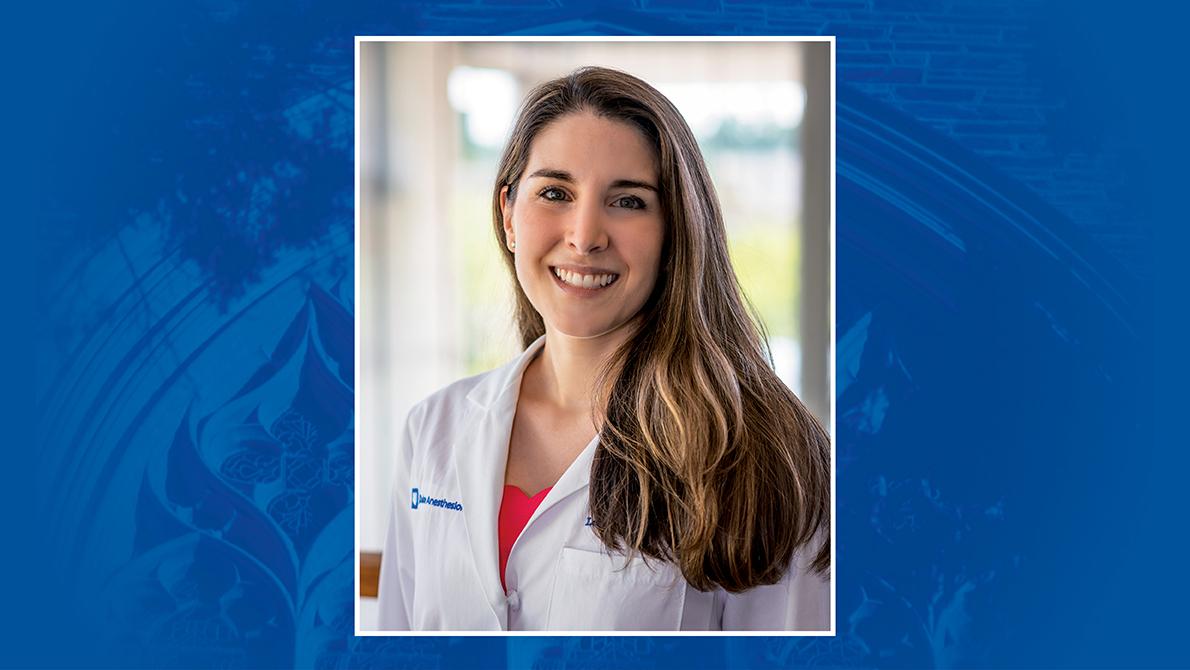
The National Institutes of Health’s National Institute on Aging has awarded Duke Anesthesiology’s Leah Acker, MD, PhD, a two-year $444,125 R21 grant for her project titled, “Bidirectional Relationships Between Plasma Tau Phosphorylation Markers and Postoperative Delirium.”
“New blood tests for Alzheimer’s disease are becoming part of clinical care for older adults, but we don’t yet know how to interpret these tests as patients are preparing for surgery,” says Acker, associate professor in anesthesiology and director of the Anesthesiology, Cognitive Neuroscience, and Engineering Research (ACkER) Laboratory. “These tests can become abnormal many years before symptoms emerge, and eventually people may make major life decisions based on these results. With that in mind, we’re doing this study for two reasons. One, we need to understand whether these blood tests can help us identify patients at greater risk for postoperative delirium so we can take additional steps to protect their brains. And two, we need to understand whether surgery, anesthesia, and delirium—if it occurs—affect these biomarker levels so that results obtained during the perioperative period are interpreted properly, especially since so many patients have blood tests drawn around the time of surgery.”
Post-operative delirium (POD) and Alzheimer’s disease (AD) share an insidious, bidirectional relationship, with each significantly elevating the risk of developing the other. A critical gap remains in understanding how pre-existing, subclinical AD pathology predisposes patients to acute neurological failure following surgery, and conversely, how an episode of delirium alters long-term neurodegenerative trajectories. Acker’s research aims to directly address this gap by leveraging novel blood-based biomarkers—specifically threonine-217 phosphorylated tau (pTau217)—to map the intersection of acute cognitive stress and chronic neuropathology.
This study frames elective surgery as a physiological "stress test" that unmasks latent Alzheimer's disease (AD) pathology, triggering post-operative delirium (POD). Investigators hypothesize that POD disrupts the "AD clock" (a predictive framework estimating the latency to clinical symptom onset based on established biomarker dynamics) through two potential neuropathological mechanisms: it either initiates new tau pathology accumulation (the clock begins to tick) or it functions as a biological accelerant that precipitates a steeper, faster-than-expected longitudinal rise in plasma pTau217 levels (the clock ticks faster).
The project is structured around two primary aims, which include 1) determining the association between pre-operative plasma pTau217 levels and the subsequent incidence of POD to evaluate its utility as a predictive biomarker and 2) quantifying the longitudinal trajectories of pTau217 over months to years post-operation to assess whether POD correlates with a greater long-term accumulation of tau pathology. Secondary and sensitivity analyses will evaluate additional blood-based AD biomarkers and examine outcomes stratified by baseline mild cognitive impairment status.
By refining the characterization of plasma pTau217 before and after surgical stress, Acker’s research aims to optimize both acute and long-term clinical care. In the short term, identifying high-risk patients pre-operatively allows for the targeted allocation of limited resource-intensive delirium prevention protocols. Long term, a more precise "AD clock" model will dramatically improve AD prognostication, offering patients, families, and clinicians a clearer window for future planning and potential therapeutic interventions targeting shared pathogenic pathways.
“Physicians and patients will soon have these results in the medical record as they prepare for surgery,” Acker says. “It’s important to understand what these results mean in the perioperative period, so patients and doctors can make informed decisions together.”